Showing posts with label Best Buy promo code 10% OFF 2016. Show all posts

Thursday, July 28, 2016

5 ways technology is revolutionizing the way we shop

Enter this Best Buy 20% OFF Coupon Code  during checkout to get 20% 50%  Promo Code Off  for activity trackers & pedometers. Check Best Buy Promo Code  10% OFF now!

No matter how easy it has become to shop online, sometimes you just want to visit an actual store. Why? Because the in-store experience matters. And it is improving all the time, thanks to technology.
Once you enter a store, advanced technology may be at work in ways most shoppers might not even realize — through devices that tell retailers when your favorite items are running low and with apps that help you navigate the floor plan. Here are just a few of the cool technological advances starting to happen in brick-and-mortar stores today.

1. Beacons

Once used primarily to alert customers to discounts and coupons, beacons — which communicate with your smartphone using Bluetooth — are starting to transform the shopping experience.
Consider a customer who walks into a retail store in search of one item. If a customer has never been in that store before, he or she might wander aimlessly down the aisles, get frustrated, and leave without buying anything. With beacon technology, shoppers can download the retailer's app, opt into beacons, and then easily learn where that item is, as beacons broadcast signals to their mobile device.
"When brands stop marketing to customers in a general way and start treating them as individuals with specific preferences," explains Maya Mikhailov, chief marketing officer and cofounder of the mobile commerce platform GPShopper, "that personalization will make customers more loyal to brands."
In the future, beacons will be able to enhance the experience of loyal customers by, for example, notifying sales associates the moment you walk into your favorite store. "Say a shopper always goes to a store on Wednesdays, but today they go on a Thursday and their favorite sales associate is out," Mikhailov says. "A Bluetooth peer-to-peer experience might allow them to share their shopping list with a sales associate in real time, and now that sales associate can give informed suggestions." 

2. Smart shelvesshopping aisleiStock

Have you ever picked up an item you thought was on sale, only to get to the register and find out the sale ended yesterday and no one updated the price? Or you head to the store only to realize the shampoo you need is out of stock ... again.
Relying on humans to update pricing or restock items ends up being costly and time-consuming for businesses. In fact, Harvard Business Review found that out-of-stock shelves cost retailers 4% of their annual revenue. That's why major retailers like Whole Foods, Walgreens, and Lowe's have turned to smart-shelf technology to monitor inventory in real time.
With smart shelves, retailers and manufacturers can scan the content of a shelf using embedded sensors and alert store employees when inventory is running low or when a theft has been detected. Retailers can also change prices of products in real time, ensuring accurate pricing for customers and saving time for associates who were once required to monitor those shelves.
Some manufacturers are also hoping to use smart-shelf technology to increase sales of their products by automatically sending shipments to stores when products are running low. Consumers would never have to worry about their favorite products being temporarily out of stock, making it a win-win for customers and retailers.

3. Virtual reality

Many brick-and-mortar stores have begun incorporating virtual reality into their in-store experience. For example, certain Lowe's locations let customers see 3D renderings of future bathroom renovations before they buy anything. Customers can meet with a trained sales representative to pick which items they want to upgrade (such as faucets, a toilet, or a tub). Once they've decided what they want, they step into a 30-by-20 room to see, using a tablet and 3D technology, how those products would look in their bathroom.
Another way retailers are meshing the digital world with the physical world is through experiences such as virtual changing rooms. In Japan, Toshiba developed a way for customers to virtually try on clothes using a digital changing booth. Shoppers simply stand in front of a 3D camera to get their bodies scanned and measured, and the measurements are uploaded to their phone. From there, customers can mix and match outfits, both in the store and from the comfort of their home, to decide which pairings look best with their measurements in mind. They can then go on to purchase items that are guaranteed to fit.

4. Retail appsman looking at app on phoneiStock

These days, there are plenty of perks to using a retailer's app that go beyond scoping out new products. For starters, consumers can track inventory at their favorite stores with a click of a button. If a store runs out of your shoe size, you can easily search a nearby location to see whether the shoes are in stock using the retailer's app. Another benefit of having a retailer's app is being able to leave your wallet at home.
Customers at chains like Starbucks and Subway can use their apps to pay for purchases and receive special discounts and promotions. National retailers such as Walmart allow consumers to ditch newspaper inserts and instead check weekly deals and pricing from within the store's app. Customers can also see how much they saved by buying specific items at Walmart compared with the store's competitors.

5. Social showrooming

A recent trend with mass retailers is social showrooming. Stores such as Nordstrom have found a great way to integrate social media into their brick-and-mortar locations. The department store encourages followers on social media to pin their favorite Nordstrom items on Pinterest, and the retailer then highlights the most popular picks in fun and interactive displays within the store.
Customers can find popular pinned shoes and handbags throughout the store with a prominent Pinterest tag attached. In addition, Nordstrom created an in-store app that helps sales associates see the most popular items on Pinterest in real time so they can swap out inventory based on demand.

Bringing it all together:

Retailers can expect technology to shape the in-store customer experience for years to come, especially in terms of social media and mobile. According to a Synchrony Financial study, 30% of people surveyed have bought something after seeing it on social media. A strong social media presence helps ensure that brands stay connected to their consumers and, in turn, drive sales both online and offline. And as mobile plays a larger role in consumers' lives, retailers who embrace mobile payments and financing help ensure a smoother in-store shopping experience for their customers.
Mobile tools, such as retail and loyalty applications, can also help to inform retailers of their customers' preferences and needs. This information allows retailers to create a customized in-store shopping experience while also catering to the demands of an increasingly digital age. For example, a mobile app could allow consumers to tag an item they see in a store and have it immediately placed in their online shopping cart. In this case, the consumer benefits from in-person customer service, as well as the convenience of purchasing at home.
In-store shopping is not going away, but it is getting an upgrade. Technology helps close the gap between in-store and online, making shopping more enjoyable for today's customer — and a happy customer is always good for retailers. 

Thursday, July 21, 2016

How to choose the best printer

You need Best Buy Coupons 20% OFF Entire Purchase Enter this Best Buy 20% OFF Coupon Code  during checkout to get 20% 50%  Promo Code Off  for activity trackers & pedometers. Check Best Buy 20% OFF Promo Code now!
Printers don’t last forever. Ink splashes collect and coagulate, bits of paper gather, rollers wear out, and ink cartridges become ever more expensive. Buying a new printer every few years can become a bit of a pain, and that’s before you even start looking at the current prices.
But you don’t have to spend a ton of money to get a reliable and versatile new printer.
By knowing exactly what you want, the features you need, the print quality you expect, and the budget you have; you’ll find that buying a new printer isn’t the money pit you thought it was.

A New Printer for the Price of Some Ink?

Unless you’re looking for a color laser jet printer for bulk document printing, it’s unlikely that a new printer will cost you any more than the price of a pair of ink cartridges. It’s a strange idea that the hardware that uses the ink through a combination of mechanical and digital processes should cost less than the total volume of ink needed to print, say, 250 sheets of paper, don’t you think?
This is largely due to the manufacturing costs of the cartridges, particularly from an environmental point of view, but there is, of course, an element of targeting customers with inflated prices.

Avoid Reconditioned/Fake Cartridges

Buying a new printer is a little bit like buying a car. You wouldn’t spend money on a new motor only to put the wrong fuel in, would you?
Similarly, it’s a bad idea to put reconditioned/refilled ink cartridges into your printer, new or otherwise. Although, of course, you should get as much use out of them as possible!
While they might be more economical compared to official/approved ink cartridges, this is a false economy. Sure, some of these cartridges mightwork, but the following might also happen:
  • The cartridge leaks
  • Ink cartridge isn’t detected
  • Cartridge displays as incompatible
So, you’ve saved money – but you’re not printing (although our own Kannon Yamada has used recycled ink cartridges without any problems).
Therefore, it is in your interest to purchase only the approved ink cartridges. It’s good to get these things sorted out, isn’t it? Let’s move on, then, to the task of finding the right printer, one that will give you the results you want without breaking the bank.

Laser Printer or Inkjet Printer?

While a laser printer is considerably more expensive than an inkjet printer (perhaps 10 times more), you need to ask yourself what print quality you expect, and what volume of printing you’ll be outputting.
Those laser jet printers that can be found in offices around the world are expensive, but they’re almost always network printers, serving two or three (or many more) users at a time. This saves space and money, and is therefore efficient.
You probably don’t need this type of printer at home.
Additionally, some laser jet printers employ a secondary replaceable component, the imaging drum, which is an important part of the print process. These can be around twice the price of a replacement toner cartridge.
An inkjet printer will be far more affordable, and with cheaper ink, and no imaging drum.

Black Ink or Color? Photo Printing Required?

Planning on any color printing? Want to print your photos?
If you only want to print in black, you’ll be hard-pressed to find a black-only inkjet printer. While they do exist, you might find it easier to load a standard color printer with only black ink, which some manufacturers support.
For photo printing, you will often find that the device manufacturer specifies particular ink and photographic paper for success here. As before, it’s a good idea to stick to this advice; the wrong photographic ink and paper combination will result in quite poor quality photos that will fade.

Wi-Fi Enabled Printing or Cabled?

There was a time when choosing a wireless printer would set you back around twice the price of a standard device, but those days are long since passed. You can now purchase a wireless printer for well under $100, which is a difficult price to turn down (of course, you could alwaysconvert your old printer into a wireless printer with the help of a Raspberry Pi).
With wireless printing, you gain the ability to print direct from your iPad, iPhone or Android device, as well as any PCs on your network. Because the printer connects wirelessly to your router, you’ll be able to print to it from a computer connected with an Ethernet cable or over Wi-Fi.
Put simply, if you have wireless devices, you need a wireless printer.

Do You Need an All-in-One?

It looks and feels high-tech, but do you really need an all-in-one printer/fax/scanner? Opting for such a device can double the price you might be expecting to pay at this stage, but if you don’t really need a scanner (a smartphone can be used instead in most cases) then you can discount this from your plans.
And few people use physical fax machines these days, preferring instead to use the Internet fax services.
All-in-ones also have a key support issue: if a feature breaks, and you send it away for repairs, you’re without the rest of the unit. So if the scanner broke and went away for servicing, you wouldn’t have a printer any longer. It is certainly worth keeping this aspect of all-in-ones in mind before opting to purchase such a device.

Make Your Mind Up Time

So, you now know what sort of printer you need. All you need to do next is place the order, whether online via Amazon, or at your local, reputable, electronics retailer. Just make sure the printer comes with ink, and that it is compatible with your operating system.
Do you need help buying the right printer? Have you had trouble finding a printer, or are you still using a really old device with no sign of it breaking down? Tell us in the comments.

Monday, June 20, 2016

Shop Smart: Finding the Perfect Washer

Best Buy Coupons 20% OFF Entire Purchase Enter this Best Buy 20% OFF Coupon Code  during checkout to get 20% 50%  Promo Code Off  for activity trackers & pedometers. Check Best Buy 20% OFF Promo Code now!

When investing in a new washing machine, there's a lot more at play than how well it cleans. First, you'll consider the type of machine you want — a traditional top loader, a top loader without an agitator, or a front loader. Budget, of course, is another concern (a full-size machine can cost anywhere from $400 to over $1,700). And which special cleaning features might be super-helpful to you? Here's how to approach the appliance aisle armed with a clear point of view.
If you have a small laundry room (or just a laundry corner): 
Full-sized washers can be 24 to 30-plus inches wide (and some machines sport bulky, contoured fronts that add to the width), so start by grabbing your tape measure. Jot down the dimensions of your space, but also check that the washer will fit through the hallways and doorways on the way into the room. And consider other limiting factors, such as a washer door that will bang into the wall every time you open it. If you're faced with a super-narrow space, a front loader that stacks with the dryer may be your best bet.
If your laundry room isn't in the basement:
First, make sure the floor is properly reinforced for the weight of the machines. You may want a quieter model with features that reduce vibration and noise during the spin cycle so it's not disruptive to your daily life. And think about splurging for a "fashion" color, since it's likely your machine may be seen by guests more often than if it were hidden downstairs.
If you have a ton of wash to do:
The tub dimensions are most important, and can range from about 2.45 cubic feet up to 5.6 cubic feet. You'll find the largest capacity on a front loader or in a top loader without the central agitator. And consider bells and whistles like programmable settings (so older kids can help do their laundry with ease) or a pedestal that will save your back from endless stooping.
If you don't want to spend a lot:
A small budget doesn't necessarily mean a sacrifice in performance, but you'll likely get fewer fancy features. And don't be swayed by trendy colors: You'll save $100 to $200 if you opt for a white model. Traditional no-frill top loaders are the cheapest, but they use more energy to run. Use the Energy Guide estimates to factor in your energy costs over the 10-to-15-year life of the machine.
If you want to conserve water and electricity:
Front loaders use way less water than traditional top loaders, which have to fill up entirely for the wash and rinse cycles. Opt for an Energy Star model, which reduces electricity and water use by 20% and 35%, respectively, over non-rated models. And check out those Energy Guide labels as a basis for comparison from model to model. However, remember that your actual costs will vary, based on your usage and the utility costs in your area.
If you're always fighting tough stains:
In our tests, front loaders provided better cleaning results than top loaders. Look for a machine with a special stain-remover or presoaking cycles, or one with a steam feature. A "cool" temperature setting that mixes in a bit of hot water with the cold will help powdered detergent dissolve completely for better stain removal.
If you're particular about clothing care: 
You'll prefer a front-loader or a top-loader without the agitator, which can cause clothing to tangle and is harder on fabric. Some higher-end models have nifty special cycles designed to clean specific materials, from denim to towels to comforters to hand-washables, and more. Also look for custom features like steam for better stain removal, adjustable spin speeds to reduce tangling, and sanitizing cycles to kill germs

Wednesday, May 4, 2016

Your Fridge: You're Using It Wrong

Best Buy Coupons 20% OFF Entire Purchase Enter this Best Buy 10% OFF Coupon Code  during checkout to get 20% 50%  Promo Code Off Clearance Mobile Phone Cases. Check Best Buy 10% OFF Promo Code now!
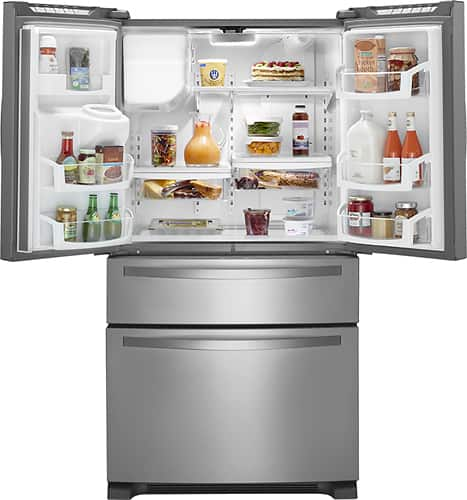
When you come home from the grocery store, you probably put away every single fruit and vegetable in the bins and drawers in your refrigerator. Any fifth grader knows that fridges work to preserve food, thus everything should go in there, right? Nope!
Chances are, you've been storing food improperly your whole life causing it to rot sooner than it should, or simply not giving it enough time to ripen. Either way, those are your hard-earned dollars that end up in the trash instead of in your belly.
A report from the National Resources Defense Council estimates that the average American throws out about twenty pounds of food per month. According to their statistics, that amounts to almost $2,275 annually per family of four. That's money that could be saved or used on a pretty nice vacation.

The cool air in your fridge stops food from decaying by ensuring that bacteria doesn't have the proper environment to reproduce. Generally, the warmer a place is, the quicker organic matter rots.
However, putting certain fresh foods in the refrigerator will affect their taste, texture, or prevent them from ripening properly, so some fruits and vegetables that you might think need to be refrigerated actually do better on the counter (at least for a few days).
After you've finished with this guide, make sure to head on over to my followup on using your freezer correctly to master the whole appliance.

Foods You Should Separate in the Fridge

If you keep finding weird brown sludge in your vegetable crisper a few days after coming back from the market, you might be storing incompatible fruits and vegetables together. Many kinds of produce emit ethylene, a type of gas (also known as the "ripening hormone," as they ripen. Keep these foods separate from non-ethylene emitting foods, and you'll get less waste.
Some examples: most stone fruits like nectarines and peaches, bananas, apples, melons, avocados, and tomatoes all emit ethylene.

Ripen These First Before Refrigerating

The aforementioned stone fruits, bananas, melons, avocados, kiwis, and pears should all be left outside, out of direct sunlight, until they smell and/or feel ripe. Then they can go into the refrigerator to extend their lifespan without affecting their tastiness.

Foods That Need to Cool Off Immediately

Other types of produce need to chill out at once. Most berries, cherries, figs, plums, corn, grapes, root vegetables (radishes, daikon, turnips, parsnips, beets) should be put away in perforated bags or containers that allow a little air to circulate.
Veggies in the green range (lettuces, leafy greens, Brussels sprouts, broccoli, green beans, spinach, and fresh herbs) should be refrigerated.
Some items, like asparagus, have special needs of their own. Trimming those green stalks and storing them upright in a container with water will keep them fresh longer.

Lemons: The Great Exception

Most folks recommend that lemons stay on the counter, but The Kitchn votes that they go in the fridge. I have to agree. Even without the plastic bag, my refrigerated lemons have lasted up to six weeks.
Image via pixstatic.com

Foods You Should Keep Out of the Fridge

Some items, like potatoes, should never be refrigerated, since the cool temperatures will turn the starch in them into sugar, adversely affecting their flavor. They should be stored away from other items in a cool, dark place, since they also emit moisture and gases that can cause other foods to rot.
Onions should be kept in a mesh bag, since the circulating air helps keep them fresh, but be stored outside as well and kept away from potatoes. (The moisture and gases potatoes emit will cause onions to rot.) The same goes for garlic. Also, once you've chopped your garlic, you should use it within a week.
Eggplants and squashes can also be stored in a cool, dry place outside.

How to Make Them Last Even Longer

Keep fruits and vegetables whole—don't pull stems out or peel off stickers, which might take away a little skin. Once you break the cells on a piece of produce, microorganisms can start to reproduce and speed the process of rot.
Many chefs and culinary students recommend wrapping leafy greens and fresh herbs in a microfiber cloth or dishtowel before putting them in a bag and storing them in the fridge. The cloth will absorb excess moisture and give arugula, kale, chard, fresh basil, and rosemary a few more days or even an extra week of life.

What About Cheese?

When it comes to dairy products like cheese, things get a little more complicated. Check out our guide to keeping cheese fresh and mold-free for help on that. If your cheese, or any of the fruits and veggies listed above do end up moldy, it might be possible to salvage them.

Friday, April 15, 2016

How to Choose the Right GPS Watch

Best Buy promo code 10% OFFShop Week Long Black Friday Deals and Enter this Best Buy 10% OFF Coupon Code  during checkout to get 20% 10% Off Clearance Mobile Phone Cases. Check Best Buy 10% OFF Promo Code now!

A GPS watch is a tool that can enhance your training—if you pick the one best suited for you.
GPS watches track time, distance, pace and calories, and come equipped with numerous features and training aids. But it can be difficult to find the right watch with so many brands and models available.
Here are four questions to ask yourself when shopping for a GPS watch:

How Often Will You Use It?

Budget GPS watches cost around $100—about the same as a pair of running shoes. Figure out how often and how far you run to determine whether it's worth buying a GPS watch. Beginner runners might not benefit from using a GPS watch if their runs are short or infrequent.
A smartphone fitness app may be a better option for new runners. Most apps have the same functions as a basic GPS watch. They're also less accurate, not as durable, and come with fewer features.

What Will You Use it For?

GPS watches are most commonly used for running. But they can also be worn while cycling, swimming, hiking, skiing, rowing, or kayaking. Just about any outdoor sport can be tracked with a GPS watch.

It's important to think about the activities where you will use your GPS watch and ensure it has compatible features. For example, not all watches can be worn in the water. If you plan on swimming with your watch, make sure it's waterproof to at least 30 meters.Some watches are designed primarily for triathletes. They come with features that make it easy to quickly transition from one sport to another. If you are not a triathlete, determine whether a watch with these features would be useful.

Tuesday, April 12, 2016

Best Buy promo code 10% OFF: Photography 5 tips to help you choose a new camera lens

Best Buy promo code 10% OFFShop Week Long Black Friday Deals and Enter this Best Buy 10% OFF Coupon Code  during checkout to get 20% 10% Off Clearance Mobile Phone Cases. Check Best Buy 10% OFF Promo Code now!
Your camera lens has much to do with how you capture the world. So when it's time to add a new optic to your kit, how do you decide which one?
You have many things to think about: sharpness, distortion, durability, focusing speed, and cost, just to name a few. All of those factors are important. But before you get to the technical aspects, here are five considerations that might help you narrow down the list of candidates.

Three different lenses, many different perspectives.

Perspective

Stand at the corner of the busiest street in your city, and shoot ten frames with a 9mm, 24mm, 50mm, 200mm, and 500mm lens. Each group of images will tell a different story.
At 9mm, you'll capture asphalt, people, cars, buildings, and sky. Narrow the perspective a bit to 24mm, and you may have to choose between the street or the sky. At 50mm you're beginning to gather more information about a subject – maybe a particular person approaching you, or a passing car. At 200mm the details begin to dominate the story, and the background becomes less important. And when you mount a 500mm lens on your DSLR in a busy city, you probably become the focus of attention as people wonder what you're doing.
The point is, visual perspective is an important part of storytelling. When you look at your existing photographs, what's missing? Do you tend to shoot tight (close up) all the time and forget to capture an establishing midrange or long shot? Maybe your photographs are lacking the intimacy that comes from focusing on details. Look for the visual gaps in your work, and consider a lens that will help you fill them.

An affordable way to add more light-gathering power to your kit is to purchase a 50mm f/1.8 prime lens (left) to augment the standard zoom that came with your camera (right).

Maximum aperture

An all-purpose zoom lens that's typically bundled with a DSLR is good at providing a variety of perspectives from wide angle to mild telephoto. But that range usually comes at the price of a conservative maximum aperture, such as f/3.5-5.6.
What does that mean? At its wide-angle setting, say, 18mm for example, the maximum aperture is f/3.5. That's the most light the lens can pass through to your camera's image sensor. By the time you zoom to 55mm, your lens is far less bright at f/5.6. Each full f-stop (f/4, f/5.6, f/8) equals a full ISO setting (ISO 400, 800, 1600). So if you had an f/4 lens instead of f/5.6, you could lower the ISO from 1600 to 800.
When shooting in dimly lit environments with a kit zoom, you'll either have to compensate for less light coming through the lens by increasing the ISO setting (say, from ISO 400 to 800 to make your camera more sensitive to light), or by adding light using a flash, or slowing down the shutter speed (for example, from 1/60 second to 1/30 second) to let more light pass through to the sensor. If you added a brighter lens to your kit, such as a 50mm f/1.8, you wouldn't have to bump up the ISO or add a flash nearly as often.
The second major impact is how you can manage the background of the composition. A large maximum aperture, such as f/1.8, gives you more options for making the background detailed or soft. Large aperture settings allow you to soften the background more easily, while smaller settings (f/5.6 and smaller) tend to render more background detail.
If your shots tend to have an even amount of detail from front to back, or if they haven't pushed the limits of existing-light photography in moody environments, then you may want to consider a lens with a larger maximum aperture. Reasonable affordable examples are a 50mm f/1.8 and a 30mm f/2.0. One of my favorite affordable "big aperture" lenses is the 85mm f/1.8. With any of these choices, you can shoot without flash indoors and have more control over background detail outdoors.

Large aperture prime lenses, such as the Sigma 50mm f/1.4 and the Canon 50mm f/1.8, make it easier to soften the background. Set the lens to its largest aperture, such as f/1.4, and focus carefully on your subject. The background will render softer than your subject.

Size and weight

Maximum aperture also influences size and weight. The larger the aperture opening, the bigger the lens. A great example is to compare professional-quality 70-200mm zooms. A Canon f/2.8 model weighs 3.28 pounds, while the f/4 version is much lighter at 1.67 pounds, about half the weight.

The f/4 version of the Canon 70-200mm zoom weighs about half of the f/2.8 model. How much weight are you willing to carry all day?

This is also the case for wide-angle zooms and fixed-focal-length lenses. A 17-40mm f/4 wide-angle zoom weighs 1.05 pounds, versus 1.4 pounds for the 16-35mm f/2.8 model. And a Sigma 50mm f/1.4 is considerably heavier than the Canon 50mm f/1.8.
Of course, maximum aperture isn't the only influence on size and weight. Robust pro-model construction also plays a part. That Canon 50mm f/1.8 I mentioned is a consumer-grade lens with plastic construction, whereas the Sigma f/1.4 is a professional model with a metal housing.

If you travel a lot and usually shoot in decent light, you can save yourself a lot of weight, not to mention dollars, by choosing a lighter zoom lens that that doesn’t have as large of a maximum aperture. The Canon 55-250mm EF-S zoom (for cropped-sensor Canons) weighs less than a pound and costs £199/$299. Its maximum aperture at the telephoto setting is f/5.6. The 70-200mm f/2.8 pro model is two stops brighter, but weighs over three times more and costs £1,500/$2,500.

How much weight are you willing to carry? That beautiful 70-200mm f/2.8 doesn't do you any good sitting on the shelf at home because it doesn't fit in the shoulder bag you want to carry while touring Paris. It's important to hold the lens you're considering and see how it fits in the bag you want to use.

Stabilization

If you shoot with a Canon, Nikon, or Panasonic camera, then you need an image-stabilized lens to take advantage of this important technology and compensate for camera shake. Those brands use optical stabilization that's built into the lens. Olympus and Pentax, on the other hand, build the stabilization feature into the body, giving you that technology regardless of the lens you've mounted on the camera.
Even though it costs more, I recommend buying stabilized lenses for those models that give you the option, especially for telephotos and long zooms. The professional-caliber Canon 70-200mm f/4 IS zoom costs $600 more than the non-IS model. That's a lot of money! But having image stabilization gives you the opportunity to get sharp shots in a greater variety of lighting conditions.

Emotional appeal

This final consideration might sound a little touchy-feely, but hear me out. Spending your money on a lens you crave versus one you think you should buy is an important factor. A lens that you bond with--one that is attractive to you, something that you deem amazing--will inspire you to shoot.
Here's a personal example. I recently invested $499 (around £330) in a Panasonic/Leica 25mm f/1.4 prime lens for my black Olympus OM-D E-M5. I selected that particular glass from a long list of desirable lenses for several reasons.
  • Maximum aperture: It has a superfast maximum aperture of f/1.4 for low-light shooting and soft backgrounds.
  • Size and weight: Even though it's relatively heavy for a Micro Four-Thirds lens at 200g, it weighs far less than the 505g of my Sigma 50mm f/1.4 for my Canon DSLR body.
  • Emotional appeal: The handsome black finish combined with a large front glass element with Leica inscription pushed my desire meter to the red zone. I simply wanted this lens more than anything else on my list.

Bringing it all together

A new lens is energizing. Photographers tend to like their camera bodies, but love their lenses. When considering your next optic, use these five criteria to narrow the list of possibilities to a handful of favorites. Think about the types of shots you want to capture, the lighting conditions where you might use the lens, and the bulk you're willing to carry.

Once you have your short list of candidates, then read reviews, study the specs, and consider your budget. After you make a final decision, go shoot and make beautiful images.